Church announcements people will act on
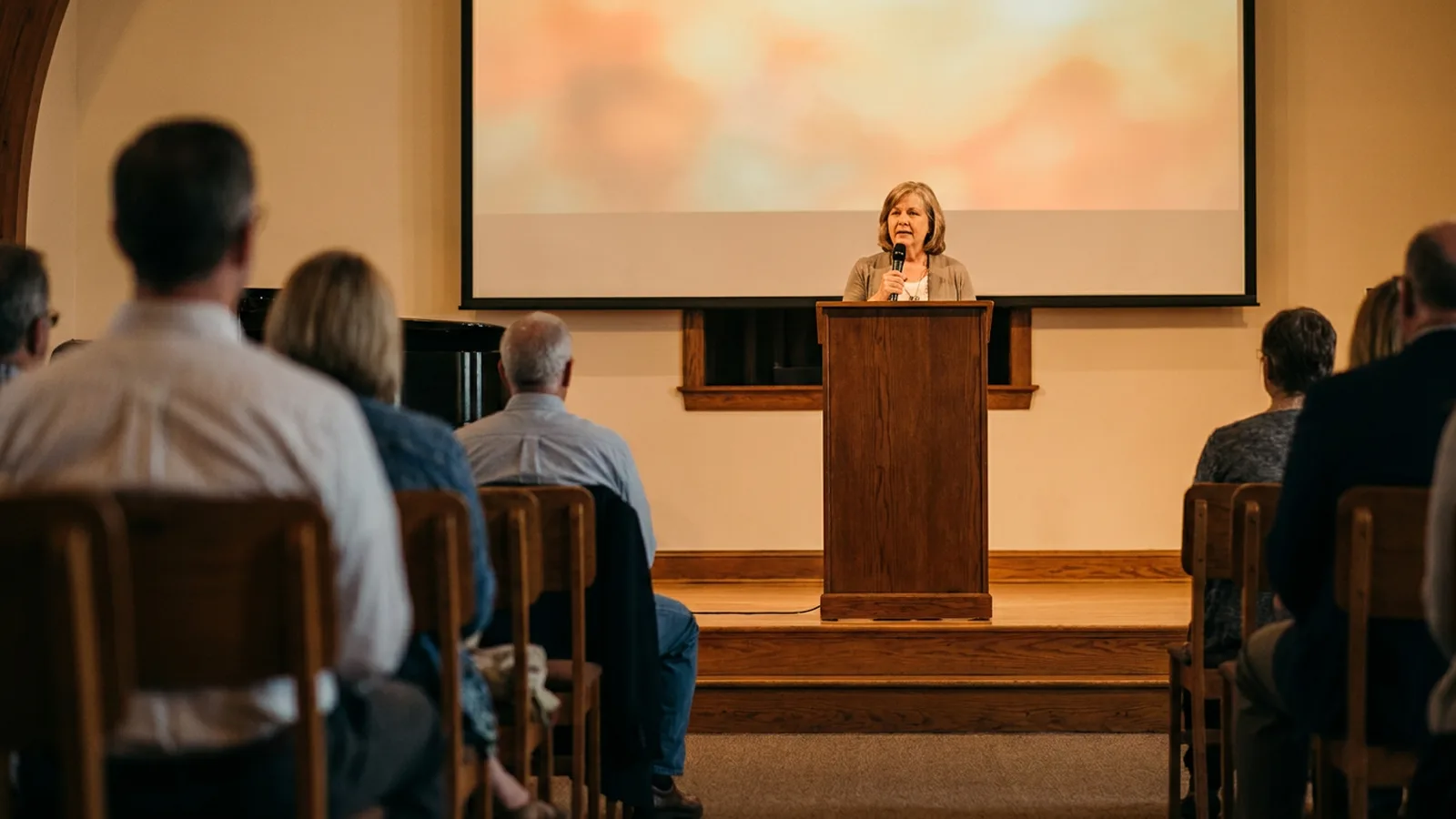
How to run church announcements people act on: which items to speak, what the bulletin must carry, and how to cut the same facts onto a slide.
Published . Updated .
Speak two or three church announcements, each one idea in about 20 to 45 seconds, and give each item one next action. Put the date, time, place, and a short description in the bulletin, and let the slide repeat only the event name, the date, and that action.
That is the order. The spoken line, the bulletin line, and the slide are three cuts of the same facts, not three different messages. ChurchPress says an effective announcement helps a defined group understand why something matters and what to do next, and that it is not a spoken calendar. Concordia Publishing House says the minimum on the page is the date, time, and place, a brief description, and one clear call to action.
Which items deserve the microphone
Stage time signals importance. If ten items get a turn at the mic, each one feels smaller. ChurchPress reserves spoken announcements for church-wide priorities, time-sensitive decisions, pastoral moments, and actions where shared attention makes a difference. ChurchPress says many churches can focus on two or three spoken items and send people to a current website hub for everything else.
Vanco's announcement guide makes the same cut from the other side: in-service announcements aimed at a small slice of the room are a common reason people tune out. A choir banquet, a committee meeting, or a class that fits one age group belongs in a note to that group. Church social media is one of those channels when the people who need the item already follow it. The stage is the wrong place to catch up a list.
Write the criteria down so ministry leaders know why one request is spoken and another is not. ChurchPress lists the spoken cases as items that benefit from a pastoral explanation or a shared celebration, and it tells the office to publish that rule. Late add-ons are a process problem, not a speaking problem. If the request arrives after the script is set, it waits for email, the bulletin, or next week, unless it is truly pastoral.
Write the spoken line for a person
Write for the ear. ChurchPress wants short sentences, familiar words, a specific date, and a conversational voice. Do not read a paragraph off the slide, and do not list every eligibility rule from the platform. Say where the complete information lives, and make that place easy to remember.
Vanco says to read the draft out loud before anyone else hears it. A line that looks fine in a document often repeats a word, or it sounds like a memo. Vanco also says to prepare answers before you stand up: how much time you have, which facts you must say, how the item connects to the church's priorities, and what would make a person in the room care. A weekly welcome, the offering, and a standing group can use a short script so the volunteer is not inventing it at the lectern.
Shape each spoken item as audience, reason, essential detail, and action. ChurchPress's formula is that order. Name who it is for in the first words, so everyone else can relax. Then say why it matters to them, not what the ministry needs from them. Vanco puts the same point as inspiration rather than a sponsored break: participation should serve the people listening, and it should connect to the church's mission.
One action is the rule. Concordia Publishing House says that if an event needs both a registration and a volunteer signup, those are two audiences. Split them into two announcements rather than stacking two asks in one breath. Vague language fails the same test. Vanco's slide guide gives the example of telling people to go see Pat, when newcomers may not know who Pat is. Name the person, the table, or the page.
Say what people will actually do. Concordia Publishing House warns against a phrase that could describe any event, and Vanco suggests a short memory from last year only when it fits the time you have. Skip the inside joke.
There is no single right moment in the service. Vanco says some churches speak at the start and some at the end. If people leave during the last song, speak earlier. If the first minutes are noisy, wait until the room has settled. Fold an item into the sermon only when it truly matches the text, not to clear a leftover calendar.
What the bulletin line must include
The bulletin is the place for the facts a person can look up later. Concordia Publishing House sets the minimum: date, time, and place, a brief description, and one clear call to action. Extra detail goes on the website or in a linked note, not into a second paragraph in the margin.
Vanco says the bulletin and the spoken list should work together, and that the bulletin should not be the only place an important item appears. If it matters enough to print, it also needs a spoken line or a church announcement video, or people who never open the bulletin will miss it. The reverse is also true. A spoken line with no printed date leaves the room holding a memory instead of a fact.
A useful bulletin line is four pieces, in this order:
- Who it is for, in a few words.
- Date, time, and place.
- One sentence on what will happen.
- One next step: a table, a person who agreed to be named, or a page.
Subsplash publishes spoken scripts you can adapt for a guest speaker, a prayer request, a small group, a volunteer ask, an event, and giving. Those scripts are a starting voice, not a finished bulletin. After you customize one, Subsplash says to build slides that repeat only the need-to-know facts, in a font people can read, and to show them before and after the service as well as in the weekly email. The line limits for that slide are on our church announcement slides page.
If several people submit copy, give them those four pieces first. Concordia Publishing House says a shared guideline saves the office from cutting a long paragraph or chasing a missing time. Ask for the owner and the date the line should come down.
Cut the slide from the same facts
The slide is a reminder, not a second script. ChurchPress says slides should reinforce rather than duplicate the spoken line: a readable event name, the date, and a short next action. The full information should also exist as text on a webpage, so it stays searchable after Sunday and so a person using a screen reader is not stuck with a picture of words.
Keep the names, dates, places, and links the same on every channel, and change only the length. ChurchPress calls the website page the canonical version, then a short spoken cut, an email block, a social post, and a text only for people who expect it. If the spoken line says "Saturday at the hall" and the bulletin says "Sunday in the gym," you have two events. Fix that before you design anything.
A code on the slide can point to the webpage, and it should not be the only way to respond. ChurchPress says to test the code from the seats and keep the destination easy on a phone. Say the page out loud as well, for the person who will not lift a phone during the service.
The Vanco announcement guide we opened has no worked example that shows one event as a spoken line, a bulletin paragraph, and slide lines together. The guide is strong on writing tips, on how to deliver the list, and on fill-in templates for greetings, giving, groups, and celebrations. The bulletin section points onward to another page. The three cuts below are the piece to add.
One event, three ways (illustrative)
These lines are illustrative. The church, the date, and the names are invented so you can see the cuts. They are not a record from a service we ran.
The item: a Wednesday soup supper that also collects names for a Saturday food drive. It is church-wide, so it can be spoken. The food-drive volunteer training, which is only for people who already signed up, stays in an email to that list.
Spoken, about the length of a short breath, not a speech:
If you can stay after the service on Wednesday, the hall has soup and a card for the Saturday food drive. The card is on the welcome table. Take one if you want to help pack bags.
Bulletin:
Wednesday soup supper, 6:00 p.m., fellowship hall. Soup, and a card to join Saturday's food drive. Cards are on the welcome table. Questions: the church office.
Slide, three short lines:
Wednesday soup supper 6:00 p.m., hall Food-drive card at the welcome table
The spoken line leads with the invitation and ends on the card. The bulletin holds the clock time and the office. The slide can be read while someone is still sitting down. The three cuts leave the grocery-sorting detail for the webpage. That detail lives on the webpage the office already maintains.
If this supper launches a named series, use that same title in all three cuts. A second title is a second event.
Run of show, and the honest limit
On Sunday, one person owns the list. The script, the slide, and the bulletin already share the same date. If the room empties early, move the spoken items forward. After the service, pull any line whose date has passed.
This order will not draft every greeting, giving appeal, or new-group script. Vanco and Subsplash already publish those fill-in templates. What they do not hand you is the single pass from spoken line to bulletin to slide. A reader who buys nothing can still run Sunday with the cuts above.
When the spoken item is the series itself, settle the title first so the slide and the bulletin use the same name. Sermon series ideas is that page. See our series launch graphics offer, coming soon at $17.00. A seasonal block such as Advent uses this same order; Advent sermon series is the planning page for that season.
Questions
How to write a church bulletin announcement?
Name who it is for, then the date, time, and place, a short description, and one next step. Keep the long story on the website.
How can I make effective church announcements?
Speak only the church-wide items, give each one action, and send everything else to the bulletin, a slide, or a message for that group.
What is the typical format for a church announcement?
Audience, reason, the essential detail, and one action. The bulletin and the slide then carry those same facts, cut to their length.
How to do announcements at church?
Read a short script, show the matching slide, and point people to the bulletin or the website for the rest of the list.
What are some examples of announcements?
A welcome for guests, one church-wide event, and a signup people can see on the way out. A ministry-only item belongs in a targeted note.
Related products
Sources
- ChurchPress: Church Announcement Best Practices: Get People to Act (2026)
- Concordia Publishing House: How to Write Church Announcements That People Actually Read (2025)
- Vanco: Church Announcement Guide: Templates, Tips and Free Downloads (2025)
- Vanco: Get Church Announcement Slide Tips and Free PowerPoint Templates (2021)
- Subsplash: 7 Church Announcement Templates (2023)