Church set design on a small budget
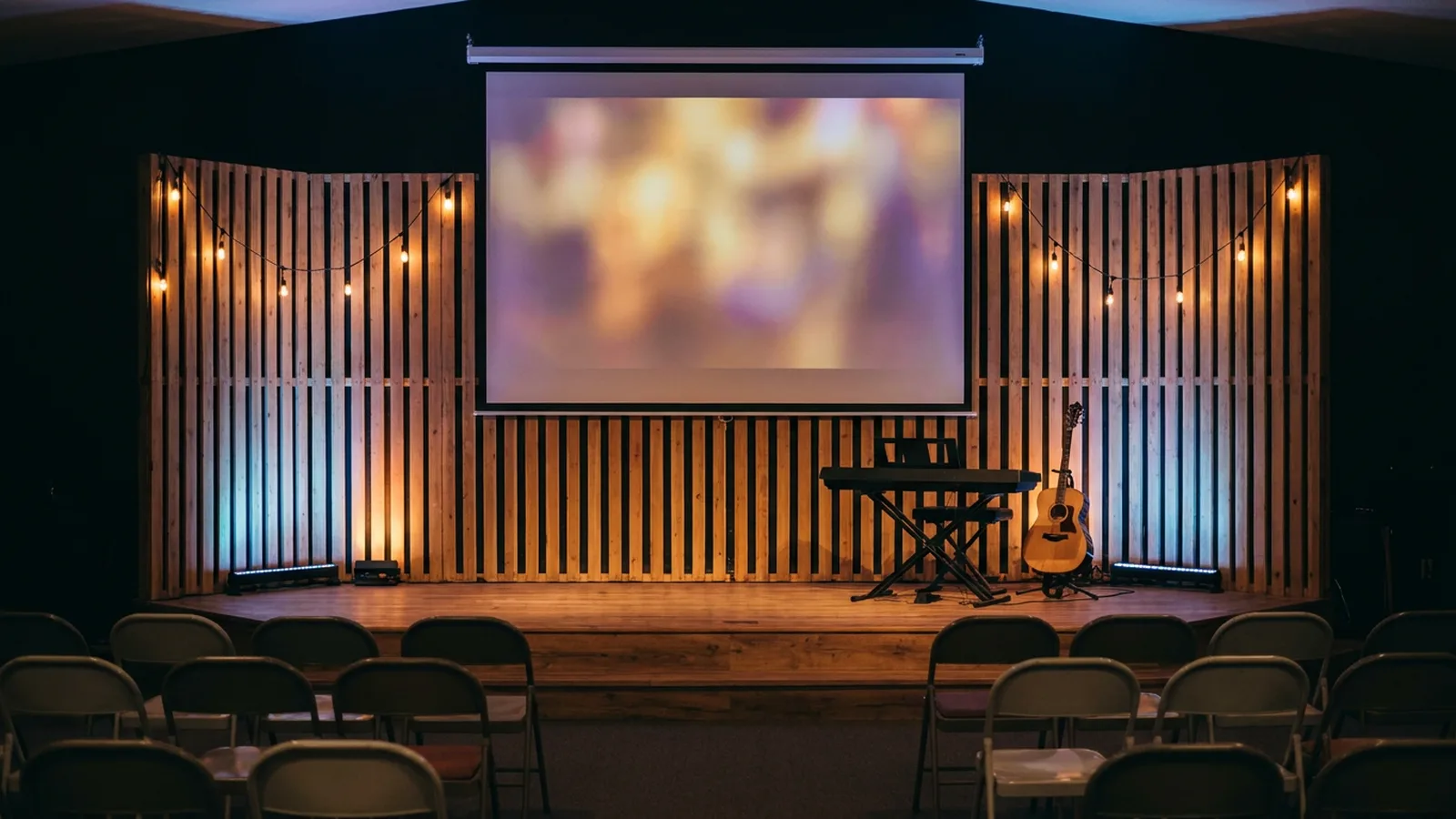
Church set design on a small budget: backdrop, lighting, and set-piece ideas, and what to put on the screen instead of building it.
Published . Updated .
On a small budget, decorate the church by building a backdrop you can reuse, lighting it, and putting the changing theme on the screen. Hartford Technology Rental puts fabrics and lighting first when the budget is stretched, calls wooden panels or pallet wood the least expensive modern look, and treats an LED video wall as the choice that comes at a cost. MediaShout puts the approximate price for a banner at around $400, and treats a screen as the budget way to swap worship backgrounds, sermon pictures, and holiday art while the set stays in place.
Hartford sorts a church background into two kinds. A scenic design takes people to a place or a story, such as a nativity, and projection is the quick way to make it. An atmospheric design carries a mood, and lighting is a very economical way to change that mood. Build the atmospheric piece. Show the scenic piece on the screen unless you have a reason to construct it.
Settle the theme before you buy a sheet of anything. The sermon series ideas guide is where that decision belongs.
Backdrop ideas by what you can spend
Spend in this order. Use what you already have, then buy one material you can cut and reuse, then pay for a single finished graphic or a short rental. Save a video wall for the year the picture itself is the set.
Fabric, drapery, and a few lights. When money is tight, Hartford points to fabric strips from the ceiling with inexpensive lights on them. MediaShout lists drapery as a budget-friendly method, with the look coming from color, material, and size. Church Relevance points to University Covenant Church, which ran simple drapery so the lines of the backdrop led to and from a cross, and calls that an efficient way to handle finances. Church Relevance also shows New Hope Seattle Foursquare using clustered balloons for a church under tight budgets. MediaShout treats balloons as an affordable decoration and not a long-lasting design, so plan them for one Sunday, not a season.
Wood and plastic you can cut. MediaShout suggests wooden panels you can paint, cut, light, letter, or leave as they are, and the largest panel spread it describes is usually one by two by eight. Hartford calls wooden panels or repurposed pallet wood the least expensive modern trend, and pairs that texture with LED screens for the content. Corrugated plastic, the sheet MediaShout calls coroplast, is the low-cost option you can cut into new shapes and use again, and it reflects light, so the fixtures can do the color work.
Church Stage Design Ideas files real church sets under tags for pallets, coroplast, string, bubble wrap, aluminum screening, and light bulbs. Use that tag list as a shopping list of materials other churches have already used on a stage, then price the material locally.
One bought banner, or a rental for one event. A backdrop banner is MediaShout's portable way to promote a sermon topic or a conference. The price varies with size and graphics, and the approximate price it gives for a banner is around $400. Order one when the graphic has to be finished and you will hang it more than once. For a single weekend, Hartford points to pipe and drape, stage backdrop panels, or a truss rental instead of a purchase, and sends the reader to a quote for the rate. This guide leaves the rental number out.
An LED video wall is the step up. Hartford says it comes at a cost, needs mounting space, and puts rigging in the budget, while a projector and a retractable screen keep more of the stage floor clear and a projector uses less power than a video wall. Hartford says a video wall gives a much brighter image in a room with a lot of ambient light, suggests a video wall might be the best option when a stage needs multiple projectors, blending and odd screen sizes in a bright room all at once, and says projectors give a more natural image when the first seats are 15 feet away or less.
Lighting that changes the same set
One backdrop can serve two services if the light changes. Hartford compares lighting to paint on a wall: color and intensity change the room, and lighting is one of the most affordable ways to draw attention, highlight what matters, or set a mood. MediaShout keeps it simpler: warmer or cooler bulbs, aimed so different sections of the stage carry the mood while the set stays the same.
Hartford names five fixture jobs: floodlights for a broad wash on a backdrop, wash lights (Fresnel fixtures, or inexpensive Par cans, which are difficult to control), cyc lights for a faint tint or to separate people from the background, spotlights that need an operator, and beam lights for a bright effect. Hartford says gels change the color and gobos add a pattern, which is how a minimal stage can feel fuller, and names front light (set mid-level so shadows stay off eyes and chins), back light, down light, and side or high side light. Hartford says a few basic lights can run on their own, and reserves a lighting console for an elaborate display.
Hire a specialist when the room needs a designed plot. That is MediaShout's option, not a step you owe every Sunday. The fixture names above are a vocabulary, not a plot.
Set pieces worth building
Hartford lists banners, plants, figurines, and furniture, made from fabric, cardboard, and wood pallets so the cost stays low. Build the piece that carries the season. Leave the piece that changes with the series for the screen.
These are the set pieces the sources show churches building:
- A cross the rest of the set points toward. Church Relevance shows University Covenant running drapery lines to a cross, and Victory Family Church hanging string lights from the rafters with one large cross in the middle.
- A series word in lights or foam. Church Relevance shows Asbury Church framing the screen with block-letter lights, and Église CMEI lining foam-board letters with LEDs so the word reads when the room is dimmed.
- Bulbs as a frame. Church Relevance shows Evergreen Christian Community setting bulbs into wooden slabs around the main screen, so the frame can be rearranged when the look changes, and Blue Ridge Community Church changing white panels with the lights they already had.
- String art. MediaShout lists wood, colored yarn, nails, and wood stain, and says church volunteers come in handy. Church Relevance credits a string-art backdrop to Lafayette Community Church.
- PVC pipe, cut into a pattern or a word. MediaShout calls the material very affordable.
- Cardboard plus a projector. Church Relevance describes St. Matthew Lutheran Church projecting a design onto cardboard pieces, sketching each piece, and assembling a cross.
- Christmas pieces you can make or project. Hartford lists snowflakes and trees and says they can be projected, plus giant ornaments made from materials you already have and then lighted. MediaShout adds a nativity, falling stars, and a living-room set.
- A simple podium. Hartford says most church pulpits are a simple wooden podium or a truss podium. Leave it in place and change the screen behind it.
For Easter, Hartford notes that some churches have built an elaborate structure of the place where Jesus was buried, and that projection on the backdrop can carry a similar effect. Build the structure only if you have the crew and the storage. Otherwise project it.
Church Stage Design Ideas tags portable stage designs for a team that sets up and tears down. The same gallery shows an offset, separated projection screen from River Run Christian Church in Chuluota, Florida: a physical frame around a screen, rather than a wall of scenery. Build the frame. Change the picture.
What the screen should carry
The screen is the part of the set that should change every week. MediaShout treats screens as a budget option because the media changes: worship backgrounds, sermon presentations, and holiday pictures, including a motion background when a still set would go stale. Hartford names projection as the quick scenic background, including a nativity, and says trees and snowflakes can be projected.
Put these on the screen, and leave them off the saw:
- The series title and the art that matches it. Build the wood or the fabric once. Change the picture when the series changes.
- Lyric and sermon backgrounds, so the band and the preacher share one look for the morning.
- A scenic story you would otherwise construct, such as a nativity, trees, snowflakes, or an Easter scene.
- The announcement frame for that Sunday. Layout for those frames is in the church announcement slides guide. The spoken list is in church announcements.
Keep the physical set quiet enough that the screen can be read. Wood, a plain fabric, and a wash of light do that. A busy built scene and a busy screen fight each other. The bulb frames and letter lights above work because they point at the screen.
Explore the Lifetime Bundle: the evergreen launch release for $399 once. Seasonal kits and future additions are not included. Check the product page for availability.
A volunteer can still build Sunday's pictures in the software the church already runs. The link above is only for the screen half of this job. The backdrop, the lights, and any banner you still want in the room are a separate job.
How to decorate the church beyond the stage
The wider question is the whole room, not only the platform. Hartford treats the space in front of the stage as part of the design: aisles, pews or chairs, and the floor, so people feel included in the scene. Start at the floor and work up in layers, and keep each layer connected to the one beside it. A fabric runner or a few plants in the aisle can do more than another object on a crowded platform.
For an ordinary Sunday, decorate lightly: a reused backdrop, the lights you already own, and a screen that matches the series. For Christmas or Easter, add one set piece or a projected scene. Hartford calls Easter a high-attendance Sunday. Plan the picture for that Sunday, and decide separately whether the stage itself needs a new build.
If the room has no stage, use the same split at the front. One physical focal point, such as a cross, a fabric panel, a plant, or the table you already use, plus a screen or a clear wall for the words. Then stop. Another object on the platform is how a small set starts to look smaller.
Questions
How can I decorate my church?
Build one reusable focal point at the front, light it, and put the changing theme on a screen. For a special Sunday, add fabric, a cross, or a few pieces in the aisles. Keep an ordinary Sunday simple so the team can reset it.
What stage design can a small church build on a budget?
Use fabric and lighting when money is tight, wooden panels or pallet wood when you can buy lumber, and a banner when you want one finished graphic. Leave scenery that changes with the series on the screen.
What should the screen carry instead of a built set?
The series art, lyric and sermon backgrounds, announcement frames, and seasonal scenes such as a nativity or snowflakes. Keep the backdrop neutral so the words stay readable.